As Albert Camus raised in The Myth of Sisyphus: “There is but one truly serious philosophical problem, and that is suicide. Judging whether life is or is not worth living amounts to answering the fundamental question of philosophy. All the rest, whether or not the world has three dimensions, whether the mind has nine or twelve categories, comes afterwards. These are games; one must first answer!”.
In reality, when placed within the perspective of the logic of karma, one clearly understands the limits of suicide as a means of escaping life…
But this does not diminish the sense of the absurd that one may feel in the face of existence !
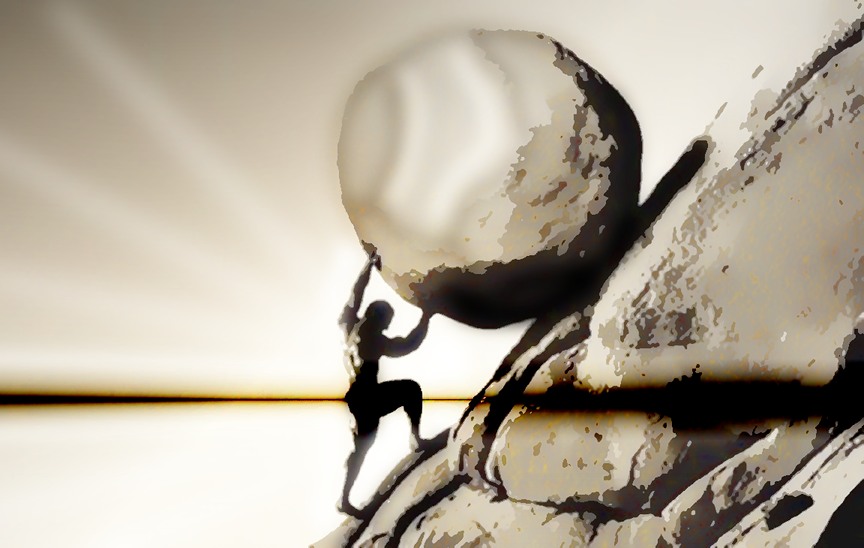
For having deceived death, Sisyphus is condemned in Tartarus to eternally roll an immense boulder to the summit of a hill; but each time he valiantly approaches the goal, the heavy rock breaks loose and rolls back down the slope…
Here we perceive both the folly of the punishment, the fact that it is unachievable, and the fate that recalls itself to the character in the form of this heavy boulder (a highly Saturn/Pluto symbolic image).
In many respects, the life of modern man can be compared to this myth: modern man is and remains empty…
Empty of everything, starting with himself. He often feels alone, isolated, as if independent from the world, as if he lived in a bubble separate from the rest of the universe, as if his own world were independent, had its own rules and its own existence apart from everything else.
And since nature abhors a vacuum, inevitably, this void often seeks to fill itself in various ways, which constitute different forms of escape, more or less dangerous and destructive: drugs, alcohol, entertainment, thrills, power, sex…
Each of us thus has our own “points of escape” !
Believing ourselves beyond everything, even beyond all law (including the most divine and sacred) we can become our own master, our own god, and follow only our own desires, our own morality, to the detriment of all else.
I have already spoken on multiple occasions in my articles about the importance of “finding meaning” in things; what is truly most central is to understand the nature of the “why ?”, not so much the “how ?” as today’s sciences seek to force our focus upon, but above all to know what underlies processes in their metaphysical sense.
As Nietzsche said:
“God is dead ! God remains dead ! And we have killed him !
How shall we comfort ourselves, the murderers of all murderers ?
What was holiest and mightiest of all that the world has yet owned has bled to death under our knives… Who will wipe this blood off us?
What water is there for us to clean ourselves ?
What festivals of atonement, what sacred games shall we have to invent ?
Is not the greatness of this deed too great for us ?
Must we ourselves not become gods simply to appear worthy of it? “
What exactly is this dead God ? Is it not above all a synonym for death to oneself ?
Has this murder truly enabled man to achieve elevation ? Individuation ?
In reality, what we have killed is not God himself, but our contact with Him, our perception of Him, His expression through us. And that murder is worse ! Even more destructive for man ! It is this that gave birth to the absurd…
This dead God is not, in reality, an entity somewhere, far away, separate from man; He is within him, not only part of him, but his very Being.
When man prays, it is to himself that he speaks above all, within his consciousness; and it is through this “internal dialogue” that alchemy operates, and it is also his existential void that prevents it, at least momentarily, for the duration of Depression.
As the Bible says, “ask, and it shall be given you; seek, and ye shall find; knock, and it shall be opened unto you”; here lies an important key to all that I have been evoking from the beginning: one must knock !
One must prepare oneself to receive the answers one seeks. One must speak to oneself, with benevolence, as the Buddhists say, “to enter into friendship with oneself”.
It is at this price that one will rediscover harmony, “the internal union”, from the personal to the collective, from the individual to the sacred and to the universe, from the creature to the Creator, the death of the absurd, the advent of meaning…