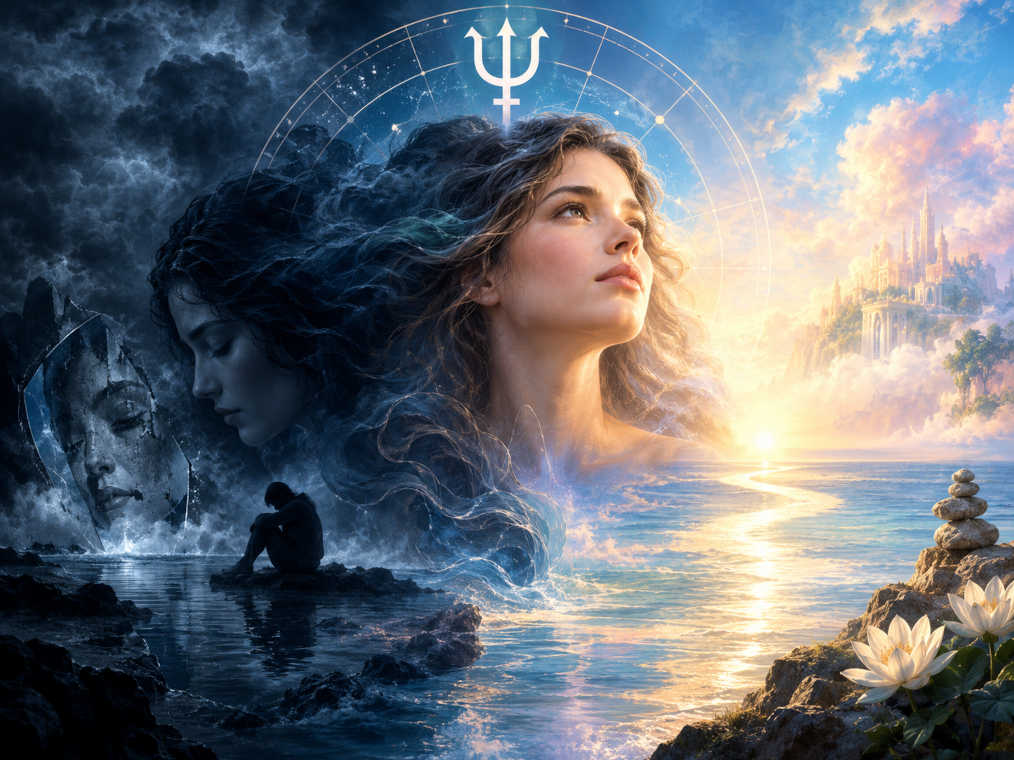
When discussing Neptune, for the apprentice astrologer, it evokes the mystery and the vertigo of the Absolute.
A true psychic ocean, the planet governs the dissolution of boundaries, the erasure of the ego, and the aspiration toward the purest idealism.
It’s that force which, at times, carries us toward the heavens, and at others, drowns us in the abyss of illusion.
To explore this duality, I have chosen to highlight the work of Liz Greene.
A psychological astrologer whose analytical finesse and clinical depth command admiration, she possesses that rare talent for translating celestial archetypes into palpable psychic realities.
In her masterful work, “Neptune and the Quest for Redemption”, she does not merely study a planet of “reverie”; she explores the Neptunian function in its greatest depths as the driver of a fundamental existential quest: that of redemption.
Throughout these pages, a crucial question emerges: how can our desire to rediscover fundamental unity and purity sometimes shift from divine inspiration toward an irremediable self-destruction ?
I rely here on the various approaches of this important book, which I highly recommend reading, to develop these points (it is a substantial volume, covering everything from mythology and mundane astrology to Neptune in aspect or Neptune in synastry; obviously, not everything will be covered here).
The Mechanism of Projection Applied to Redemption: The Quest for an External Savior
At the heart of the archetypal Neptunian psyche lies a sense of lack, a sort of “original sin”.
Drawing upon theological and mythological concepts, Liz Greene vividly describes this sense of separation (the estrangement from Eden, from the sense of undifferentiated unity, from contact with the divine) as a profound wound present in human psychology.
For the individual, the material condition, with its limits and sufferings, is experienced as a prison, an imperfection of being that must imperatively be expiated or transmuted during this incarnation, and this is a major function that Neptune awakens.
From this sentiment arises the central archetype of the Redeemer.
Since we feel unworthy (incomplete) or “sinful” due to our instinctive nature, we desperately seek a figure of superior purity, a savior, an ideal, or a deity, capable of paying the “ransom” in exchange for our existence and our faults.
We project onto the Other the capacity to redeem us from our own duality and expect a form of salvation from them.
However, this mechanism of Projection is a formidable trap!
This is what Liz Greene calls the “mirror game”, closely linked to the Karpman drama triangle, which I have explored in my article on the “victim / savior” duality.
By idealizing the other, we create an image of perfection which, by contrast, highlights our own sense of insufficiency.
This tension often becomes unbearable in the end, and the idol we have created often ends up being crucified, demolished, or vilified, blamed for failing to live up to all that was expected of it (this is the fall of the Redeemer).
We tear apart our idol because its assumed perfection also reflects our own decay.
And in this psychological drama, which is also frequently found in relationships, the roles are interchangeable: we constantly shift from the status of a victim seeking salvation to that of a disappointed or disappointing executioner, or from the one seeking a savior to the one who offers themselves, through sacrifice, to the role of martyr, acting as a lightning rod for redemption.
The Breath of Unity: Neptune as a Source of Inspiration and Grace
Yet, Neptune is not merely this decay within redemption, these illusions and disillusions; the planet is also the breath of life.
If we move away from projection toward a purely internal (introspective) experience, the Neptunian function reveals its most luminous face: the “Pneuma”, that invisible breath which connects the soul to the universe in a permanent exchange.
This dimension is beautifully expressed through the concepts of Sophia (Wisdom) and the anima (the Soul).
Here, the Neptunian function acts much as an agent of healing, a balm of soothing and acceptance.
Through the figure of the spiritual Great Mother or intuitive wisdom, the individual can rediscover a connection with the sacred; this is the entire influence of the two Water planets, the Moon and Neptune, which must necessarily articulate within the personality (receptive feminine values).
This is the moment when the veil of the senses thins to allow grace to pass (reminiscent of hexagram 22 of the I-ching of the same name).
This grace sometimes manifests through experiences of fusion with “the All”.
It permeates art, music, theater, caregiving, and even astrology itself.
When we are touched by a melody or a profound astrological interpretation, we are not merely observing a phenomenon; we are experiencing an immersion into an interconnected substance, a communion with the invisible that reminds us of the primordial unity of creation.
The Dark Side of the Quest: Addiction as False Redemption
“It is not only through the elements of the Mass, nor through holy relics, nor through the precious artifacts of our own lost Edens, that we seek redemption. We may also seek darker Neptunian substances, such as heroin or alcohol. In this context, we can begin to understand the relationship between Neptune and the addict. Addiction is a complex matter; anyone who has attempted therapeutic work with an addict dependent on heroin or alcohol will know that while the addict’s right hand desperately clings to freedom, their left is secretly bound to the miraculous redemption hidden within the poison. No logical reasoning can penetrate this Neptunian realm, for the substance that is manifestly destructive is, for the addict, the very flesh and blood of the redeemer, capable of liberating them from the prison of incarnation and opening the long-lost gates of Paradise.”
In this quotation, Liz Greene highlights the duality so present between the naturally numinous Neptune and that which is reached through drugs…
But beware: the boundary between ecstasy and the abyss is extremely thin.
The desire to escape the “prison of matter” and to rediscover lost unity can, if not channeled, drift toward paths of destruction.
Drug addiction is, in essence, an attempt at redemption through dissolution.
The use of substances, whether drugs, alcohol, or even dependency on medication (such as the OxyContin crisis in the USA or France being the world leader in the consumption of antidepressants and anxiolytics), can be analyzed as a search for oblivion.
This is particularly true for certain drugs that “put to sleep” or are analgesic and anesthetic, such as heroin, hashish/cannabis, opium, or fentanyl, which are very “Neptunian” in nature (in contrast to other more stimulating drugs like cocaine or amphetamines, which involve other planetary functions in astrology).
The individual seeks to provoke a chemical dissolution of the ego, an artificial way to break the boundaries of the body to rediscover unity and to anesthetize the pain of existence to return to an undifferentiated prenatal state.
It is a quest for grace and the expansion of consciousness that actually uses the poison of the drug as a medium of mediation.
The alchemists spoke of this hundreds of years ago as “corrosive acidic waters”, which produce rapid, radical, and extreme transformations, but which can be highly destructive and fatal to individuality…
As Liz Greene also points out, this addictive drift extends to the relational and affective spheres as well !
Sexuality can very well become an unembodied Neptunian refuge, and the orgasm is also one of the Neptunian gates that can be activated to rediscover the fundamental unity of Yin and Yang.
In this context, the other is no longer necessarily a “real” person with whom one interacts, but an instrument used to erase and dissolve oneself (by reforming a “couple” unity).
One then seeks, through the sexual act, not the encounter with the other, but merely the annihilation of one’s own solitude and anxiety, curling in on oneself like the Ouroboros, until suffocating in oblivion (closely related to what is known today as “chemsex”, essentially drug-fueled orgies).
Ecstasy and the Fall: The Paradox of the Mystical Experience
“« It was incredible. I opened my eyes to find the room bathed in light, a golden glow that made everything fresh and vibrant. It was as if I were seeing the world anew, for the first time. It brought tears to my eyes. Everything was so beautiful, so precious. I felt sanctified and restored to my integrity. Life was profoundly good; wars, quarrels, and grievances seemed trivial. Love, universal love, was the only reality… But I was not thinking. I simply knew. There was no fear, only light, love, and a peace that defies all description. It was total; time had stopped, every moment seemed infinite and blissful… Yet, as intense as this feeling was during its duration (it lasted about eight hours, then gradually faded over time), that is how devastated I felt when it left me. It was worse than if I had lost everything: my husband, my child, my parents, and my best friends. I felt as though I had been banished, that the door to the spiritual realm had slammed shut before me. I felt unworthy, more so than I ever had before. My existence seemed superficial and futile without this vast, loving consciousness. »
When the knowledge and experience of unity, love, and the joy of life begin to fade, a personal crisis may ensue.
The healing potential of such an experience is evident. Its true nature is a mystery and cannot be reduced to a mere fantasy state of fusion with a divine mother-creator.
The revealed prodigious intelligence, which gives meaning to a life pattern previously devoid of meaning and incomprehensible, if it is not divine in the conventional religious sense, certainly lies beyond any capacity of the conscious ego. However, the addictive properties of this “oceanic peak experience”, particularly for an individual who already finds life too tribal, are equally evident.”
In this quotation, Liz Greene recounts and comments on a testimonial of a Neptunian mystical experience from one of her clients.
To understand this shift, it is necessary to pause on the concept of “Peak Experience”, a term popularized by humanistic psychologist Abraham Maslow.
A peak experience is a moment of intense consciousness, an epiphany where the individual feels total unity, absolute peace, and an absence of fear.
It is the radiance of revelation, a golden light that seems to sanctify existence, which can be likened to a profound mystical state.
However, the reverse side of this coin is of incredible violence…
The trauma of the end of the experience (the brutal return to material reality) causes a sense of banishment and must be managed as best as possible.
When the state of grace fades, the world suddenly seems dull, empty, and meaningless. The individual feels exiled from their own paradise, of which they had only a mere foretaste, but which they are now unable to sustain with the same intensity !
One must return to work, chores, bills, disputes, the heaviness of the body, and sometimes illness, essentially, all of materiality…
The risk of a personal crisis is therefore major.
Human beings are not designed to live in perpetual ecstasy; their lives are not adapted to it, as the psychic structure requires a certain amount of tension to remain stable.
For some, the difficulty in reintegrating reality can lead to an obsessive quest, a veritable “hit” of ecstasy, where one seeks to relive the intensity of the vision at all costs, at the risk of sinking into profound psychological distress.
Yet, this type of mystical experience is profoundly precious in itself; if it occurs even once in a lifetime, it can open deep spiritual understandings, and one must have the wisdom to understand that it is not meant to last for the entirety of one’s incarnation…
Astrologically, certain cycles will obviously be particularly important to track as precursors to this type of experience, such as a progressed Sun conjunct Neptune, or a Neptune transit conjunct the natal Sun or Moon, etc.
Toward a Better Global Integration of the Neptune Function
Ultimately, Neptune presents us with an almost schizophrenic eternal drama, well symbolized by the sign of Pisces: two beings linked by a thread but swimming in opposite directions, one diving ever deeper toward absolute unity, the other having to accept their present state with wisdom.
Therein lies both the fundamental need to dissolve and the remedy that can heal and spiritualize everything.
The challenge of our psychological and spiritual evolution lies, therefore, in the integration and balance of this Neptunian function, according to how it expresses itself in our birth chart, how we understand it, and how we have been able to express it in our lives.
The true Neptunian redemption highlighted by Liz Greene does not reside so much in the perpetual quest for an external savior or a chemical substance that would free us from ourselves, but in the ability to cultivate this fundamental inner unity without losing oneself, throughout one’s life.
It is about succeeding in finding the sacred at the heart of the everyday, without dependency or excessive attachment, perhaps by knowing how to marvel at the small things that punctuate our days…
The ultimate goal is to transform this quest for salvation into a transformation of the “Ego Ideal”.
Rather than seeking to flee the ego, we must learn to elevate it, to spiritualize it, so that our consciousness becomes a stable and conscious vessel for Neptunian grace, capable of navigating the waters of the unconscious without ever again fearing submersion.