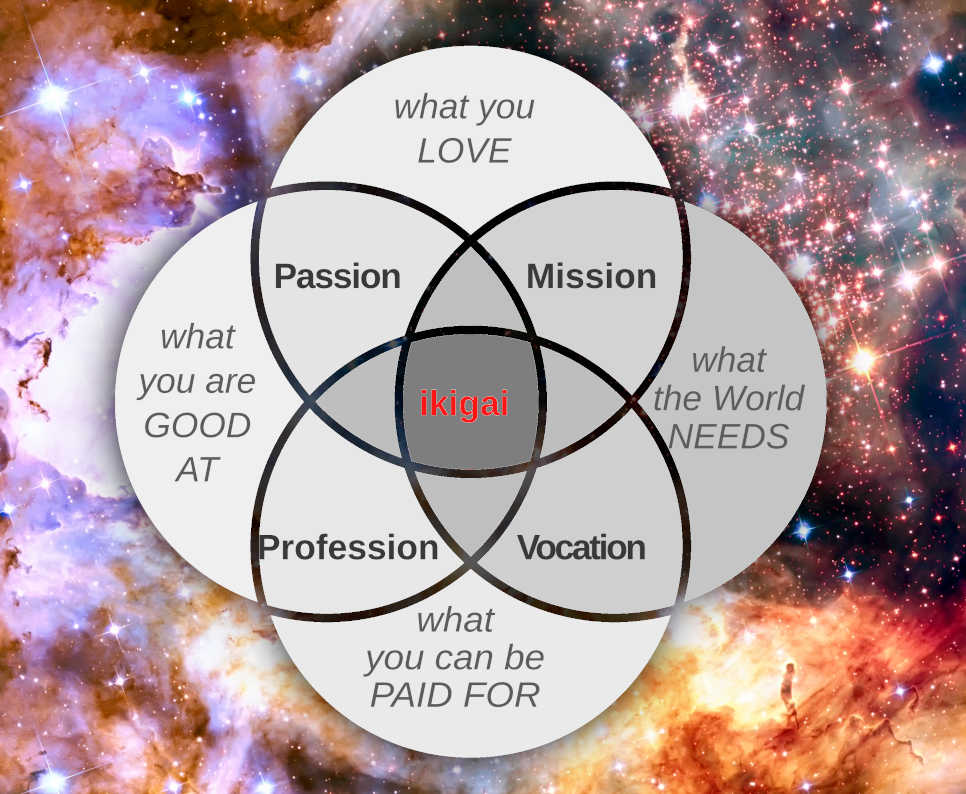
The Japanese have an interesting concept, “Ikigai”, which could be translated as “the reason for living”, in the sense of one’s ultimate life purpose, vocation, and the feeling of fulfillment and connection to the Self, to one’s share of the Absolute.
In her book, “Finding Your Ikigai”, Christie VANBREMEERSCH develops the different interactions that lead to a more precise determination of this life purpose.
As shown in the referenced diagram, Ikigai lies at the crossroads of several notions : what we love to do, what we are good at, but also what may allow us to be socially recognized and to gain some material benefit from it !
Here we are dealing with a quaternary structure that is reminiscent of our 4 Astrological Elements ! And, just like in the “fire triangle” taught by firefighters, if one of the 4 points is missing, Ikigai becomes “off-centered” and therefore cannot bring genuine balance…
If we put too much emphasis on what we love to do at the expense of the other realities, we may become disconnected from reality, fail to be useful to others, fail to be recognized, and remain isolated, in a certain material precariousness.
Conversely, if we prioritize security, we may indeed enjoy material comfort and ease, but we also risk selling our soul, losing ourselves in work whose deeper meaning we struggle to recognize. This inevitably impacts self-esteem, and the existential void may become profound, humans are, at their core, spiritual beings above all else…
We may also focus on what we are talented at, regardless of what we love, and without necessarily taking into account the real need others may have for our skills.
The risk here is significant inadequacy and misalignment with our environment, somewhat like the saying, “when all you have is a hammer, everything looks like a nail”.
We then risk trapping ourselves in our specialization and trying to solve everything in a monomaniacal way.
Conversely, if we focus only on the needs of others, we inevitably overlook our own tastes and needs. True, we may gain social recognition, but this might not fully correspond to our fundamental purpose.
The risk is to turn into a machine, capable of producing a lot for others, but at the expense of oneself, of what we feel, think, and truly are…
Here, I attempt to reproduce an Ikigai diagram that incorporates the different astrological values. Ikigai would likely be, to some extent, the blend of the Sun and Jupiter (Jupiter being, in a way, the solar booster), with the other planets revolving around them like a prism for these solar and elemental energies.
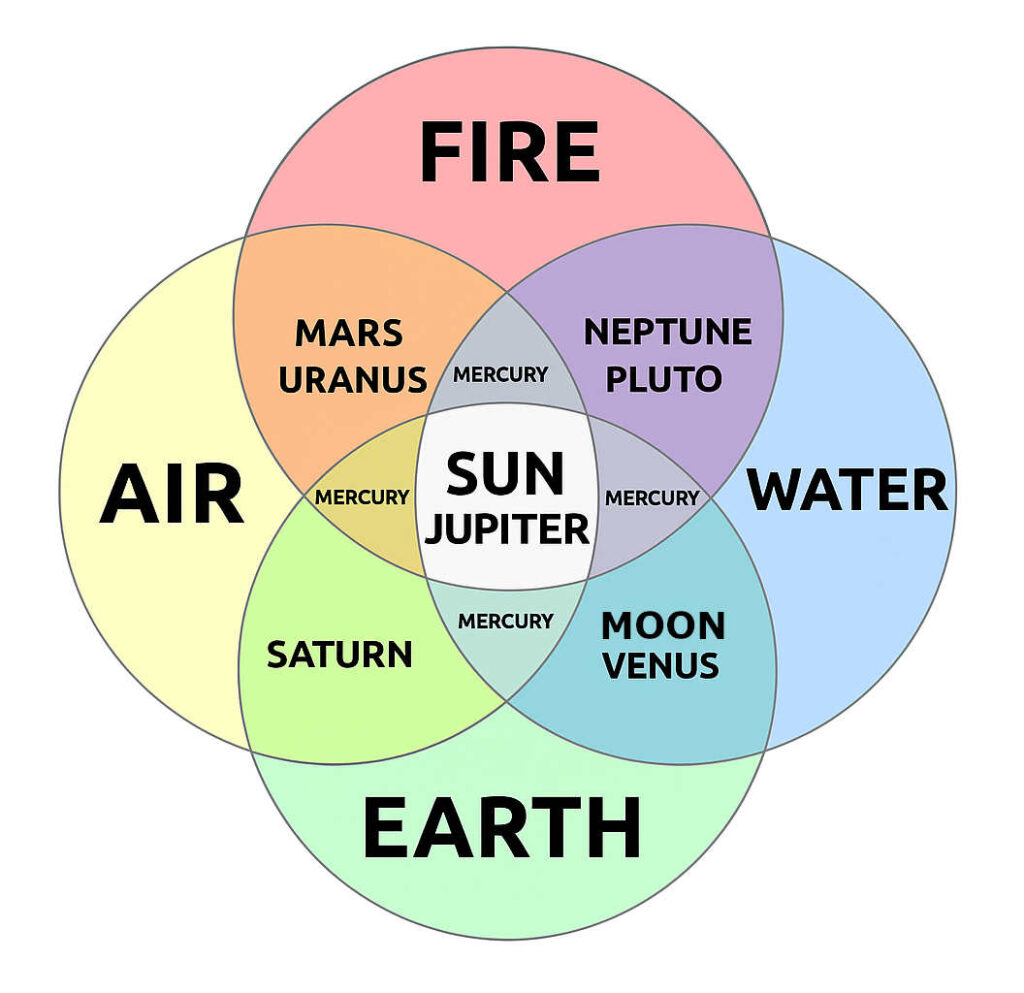
We clearly find the synthesis that must occur in every birth chart to fulfill one’s Sun…
The blend of principles of action, intellect, and emotions gives substance to solar will within material reality.
We also better understand how any “decentering” can affect the entire structure, how an excess or deficiency of elemental energy can make the Ikigai “drift” and complicate its realization.
This Ikigai concept can provide valuable introspection for each of us at important turning points in our lives. Let’s ask ourselves the right questions :
- Are we doing what we love ?
- Are we skilled at what we do ?
- Do we feel recognized socially by others ?
- Do we have the minimal material comfort we aspire to ?
It’s likely that the true, profound realization of your Sun depends on the synthesis of these 4 points…
If one or several of these points receive a negative (or “not positive enough”) answer, it’s likely that something in your reality needs to change for you to realign with your Ikigai.
It should be noted that Ikigai is obviously not something permanently acquired or fixed. On the contrary, it’s something one must fight for at every moment, a structure that can be completely shaken by the various Transits and Progressions you experience, and thus something to be continually reclaimed…