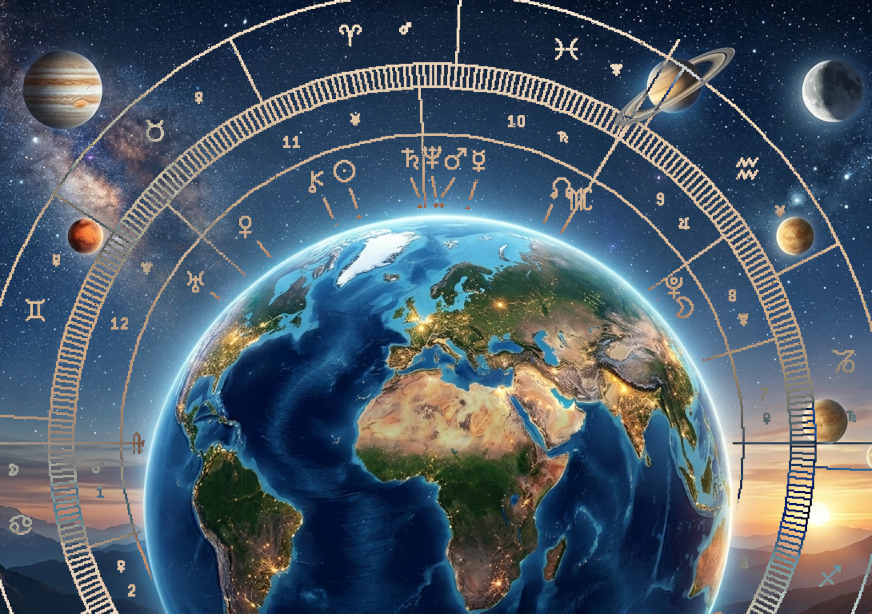
Mundane astrology focuses on the collective dynamics that traverse human societies.
Where individual astrology seeks to illuminate a person’s journey (their personal potentials and challenges) mundane astrology considerably widens the lens, attending to broad movements: those of nations, peoples, societies, political and economic systems.
It thus allows us to bring to light the major trends that shape an era.
Through the study of planetary configurations, it offers a symbolic reading of collective mutations, whether societal, ideological, or geopolitical in nature.
The aim is not to predict events in a fixed, deterministic manner, but rather to understand the energetic climates in which they take form, and which may repeat, mutate, or evolve.
For yes, in mundane astrology, one can analyze the “birth chart” of a country, even if it is not always straightforward to discern its “birth date”, since a country is a fluid social entity, constantly evolving and never truly dying.
Thus, it may experience “political plot twists” that modify its structure, and consequently, its astrological analysis.
Generally, in mundane astrology, one therefore retains as a “country’s birth date” major political events: revolutions, constitutional signings, and so forth.
Foundations of Mundane Astrology
Mundane astrology rests on the analysis of various astrological charts, especially by cross-referencing them with the cycles of the slow-moving, social, and transpersonal planets (Jupiter, Saturn, Uranus, Neptune, and Pluto).
Among the most important charts are those of nations, generally calculated from key dates such as independence or the promulgation of a constitution.
These charts serve as a foundation for understanding a nation’s deep identity, its internal dynamics, and its manner of interacting with the rest of the world (thus, for example, one might say that a given country is strongly marked by a particular zodiacal archetype or planetary function).
To this are added charts of significant events, which allow one to study pivotal moments: crises, revolutions, political agreements, or major transformations.
These punctual charts enrich the understanding of collective processes currently unfolding, they can, in a sense, update an older political dynamic, thus refreshing the birth chart of the country in question.
Certain astrological elements take on particular importance in this framework.
The astrological houses, notably the 10th House, the 7th House, and the 4th House, play a central role.
The 10th house relates to power, the State, and international visibility; the 7th house concerns alliances, diplomatic relations, and declared conflicts or enemies; the 4th house evokes a country’s foundations, its territory, its people and roots, its conservative nature, and so on.
The slow-moving planets also occupy an essential place !
Jupiter and Saturn mark relatively rapid social and political evolutions: a 12-year cycle for Jovian forces and a nearly 30-year cycle for Saturnian forces, which are thus more linked to generational dynamics.
Uranus, Neptune, and Pluto, due to their slowness, mark entire generations at a profound level, acting upon deep and enduring processes, structural societal mutations.
Their influence extends far beyond the individual framework to inscribe itself within large-scale collective transformations, often, therefore, particularly stirring and transformative (somewhat akin to what I addressed in my article on astrological generations marked by certain cycles).
The notion of cycles is fundamental: Mundane astrology is not limited to isolated events; it is inscribed within a cyclical vision of time.
Planetary configurations repeat according to precise rhythms, drawing phases of evolution, growth, crisis, or destruction, then renewal and decline, before beginning anew, unfolding across history over centuries and centuries.
The Central Role of the Major Planets
Among the most determining factors in mundane astrology, the slow-moving planets play a major role, each carrying a specific dynamic that manifests on a collective scale.
+Uranus embodies rupture and innovation.
The planet intervenes as a necessary destabilizing factor, breaking rigid structures to open the way to new forms, to revolutions.
On a global scale, its action may manifest through revolutions, major technological advances, or sudden shifts in mentalities (even complete inversions of values, where, for example, one generation may follow a path totally opposite to the previous one, such as moving from monarchy to republic, as with the French Revolution of 1789, strongly marked by Uranian energies).
This often acts in an unpredictable manner, introducing a dimension of surprise and the unforeseen into collective events.
For example, with the advent of artificial intelligence and its ultra-rapid development, one may link this to Uranian forces in mundane astrology.
+Neptune, for its part, acts on the plane of ideologies, beliefs, and collective imaginaries.
This can inspire spiritual, artistic, or humanistic impulses, with lofty fundamental ideals, but also generate phenomena of illusion, confusion, manipulation, lack of realism and pragmatism.
Its influence is found in great ideological waves, mass movements, but also in the collective narratives that structure the perception of reality.
This is a planet strongly linked politically to communism and socialism.
+Pluto symbolizes processes of profound transformation, often in a violent and destructive manner as well.
The planet often acts in the shadows, revealing what is buried, bringing to light power structures, mechanisms of domination, or zones of corruption, while also bringing deep societal taboos to the surface so they may be addressed.
Its influence is frequently associated with periods of crisis, power struggles, but also of major regeneration.
Through it, systems reach a tipping point where one form must die to make way for another.
This is a planet strongly linked to authoritarian and dictatorial regimes (which do not listen to the people and require scapegoats as lightning rods for public frustration).
These three planets, through their interactions and respective cycles, contribute to shaping the great historical dynamics, each acting on a different but complementary plane, and all together weaving the various evolutions of society.
Note that, often, a country or a political period is marked by a blend of these different influences together; they are rarely “pure”.
The Great Historical Cycles
One of the major contributions of mundane astrology lies in the study of planetary cycles and their recurrence throughout history.
Among them, certain conjunctions play a particularly structuring role, such as those of Jupiter and Saturn, often associated with phases of social, economic, and political reorganization (notably rhythmizing economic crises as well).
Longer cycles, involving planets like Pluto or Neptune, allow one to observe foundational transformations extending over several decades, or even longer.
These cycles correspond to profound mutations of collective structures, whether economic systems, governance models, or dominant values.
The observation of repetitions in history constitutes a key element of this approach !
Without claiming an identical reproduction of events, one notes that certain planetary configurations regularly coincide with similar types of phenomena.
Periods of economic tension, revolutionary movements, or major shifts in mentalities can thus be correlated with specific cycles.
It is important here to begin, in a first step, from what one observes historically, in order to then analyze the astrological cycles that applied to them.
These correspondences invite us to consider history not as a random succession of events, but as a rhythmed process, structured by recurrent natural dynamics (breaths, ebb and flow, what one generation builds, the next undoes, and so on).
Mundane astrology thus offers a interpretive framework allowing one to reposition historical events within a broader context, linked to evolutionary cycles.
For example, recently regarding the war in Iran, it was noted that the initial dynamic of hostilities occurred around late spring and early summer 2025, precisely at the onset of the Saturn / Neptune conjunction phase in early Aries.
The war halted quickly; we see that these two planets were at the end of their cycle and also retrograded rapidly.
Then the same conflict resumed from February 2026, when the two planets began to reform the same conjunction, this time definitively, exactly, and with slightly longer duration…
There is here an obvious correlation of cycles and dates (probably also linked to the nature of the astrological charts of the various belligerent countries), and this actually occurs quite frequently.
Moreover, Saturn/Neptune cycles also rhythmize economic phases of recession, which is likewise linked to this period.
What Are the Limits of Mundane Astrology ?
Mundane astrology proposes above all a symbolic reading of collective dynamics.
It does not claim to determine the course of events in an absolute, deterministic manner, but rather to highlight trends, climates, and periods conducive to certain types of transformations, to the expression of certain political currents.
It is essential to recall that these influences do not impose themselves in a mechanical, automatic fashion.
Human societies retain a degree of freedom in how they respond to the dynamics at play, depending also on the awareness they hold of them.
Free will, on a collective scale, manifests in the political, cultural, and social choices that orient the course of history.
But in a certain sense, mundane astrology can also be viewed as the sum of all individual astrology, of all the choices we make personally, at our own small level (see my article “Personal Power: Our Daily Choices That Truly Shape the World“).
From this perspective, mundane astrology may be envisaged as a tool for deeper understanding rather than prediction.
It invites us to take a broader view of the various evolutions of the world, inscribing them within cycles and processes that transcend the present moment, and thus opens the way to deeper reflection on the meaning of the transformations traversing human societies and political systems.
The most significant difficulty remains properly defining both the correct birth chart for each country, or each regime, and knowing which cycles to prioritize in linking to them.
This is never necessarily obvious and demands considerable analysis and cross-referencing, as well as advanced historical and political knowledge, thus not necessarily within everyone’s reach.
If this theme of mundane astrology interests you, some astrologers have written extensively on the subject, producing highly interesting works…