Primary directions are one of the techniques used in astrological forecasting. They are based on the principle that the hours following birth symbolically describe key stages in an individual’s development, according to the correspondence 4 minutes = 1 year (some astrologers work instead with 1 degree of right ascension).
In this way, an entire lifetime unfolds within the hours after birth: for the 40th year, for example, the chart must be cast 160 minutes after birth (2 hours and 40 minutes later).
One of the advantages of primary directions is the level of precision they can offer in certain cases, but their major drawback is the need for a highly reliable birth time, as even small inaccuracies can lead to significant dating errors.
Moreover, this is certainly not the easiest predictive technique to master…
Understanding Primary Directions
Primary directions (like Secondary Progressions) are based on the idea that birth is not a fixed, static event, but rather a moment within a dynamic process that continues beyond the first breath.
The latent potentials of the personality gradually unfold according to a developmental pattern, a chronological process of evolution.
Primary directions therefore correspond to the study of the arcs of diurnal motion formed by planets or fictitious points, and their relationship to the natal configuration.
Symbolically, the whole of life is developed within the hours following birth.
In simple terms, primary directions are based on motion in a clockwise direction (as opposed to other predictive techniques).
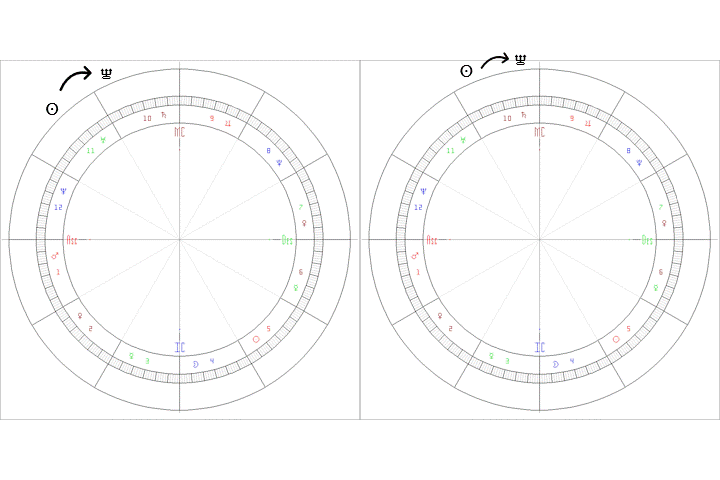
For example, if a planet is located in the 10th House in the birth chart while the Sun is in the 11th House, the aim is to determine from which point in time (at which age) the Sun, moving upward through the sky, will reach a conjunction with that natal planet…
As illustrated in the example below:
Primary directions are therefore directly linked to the importance of the astrological houses (and thus to the house system) and to their evolution in relation to diurnal motion (the rotation of the Earth from west to east, which produces the apparent movement of the celestial bodies).
Through primary directions, it becomes possible to date certain major events marking the course of an individual’s life.
However, the “period of effect” of directions is particularly delicate to assess. Since just 60 seconds of direction correspond to 3 months of life, great precision is required, and yet error remains very easy.
The main points studied are known as significators. These are the elements whose movement and the aspects they form are considered the most meaningful:
- Sun: will, vitality, radiance, Individuation, health, the Animus
- Moon: private life, daily life, physiological balance, the Anima
- Ascendant: all matters relating to personality and vitality
- Midheaven: the socio-professional sphere and personal fulfillment
Some astrologers also include the Part of Fortune or other Arabic Parts.
In absolute terms, however, any movement involving a celestial body or a fictitious point is significant (or can potentially be).
The aim is to determine the moments when a “significator” forms a particular aspect with another planet, which is then referred to as the “promissor”, in a way somewhat comparable to the system used in horary astrology…
In the example given above, the Sun in the 11th House is the significator, while the planet in the 10th House might be Neptune.
When, at a certain point in the person’s life, the Sun reaches the same position in that house previously occupied by Neptune, one may assume a particular outward expression of that planetary function, especially here within the socio-professional sphere…
Speaking of chance in astrology would be illusory for anyone who knows how to observe the principles of synchronicity and analogy.
Everything in the sky is meaningful: all planets, changes of houses and signs (and thus of astrological elements), even changes of decans, angular relationships and modifications of aspects, midpoints, focal points (see the Void in astrology), fictitious points, asteroids, fixed stars…
Very often, there is also a clear correlation between predictive techniques.
For example, a particularly important year may be highlighted simultaneously through secondary progressions, transits, solar returns, primary directions, symbolic directions, and so on.
The choice of the house system depends on what one wishes to analyze, and I would advise maintaining the house system with which one is most familiar. Placidus domification emphasizes diurnal motion, which is more analogically aligned with the principle of primary directions, but equal houses can also be relevant (this also depends on whether one works in the sidereal or tropical zodiac). At the very least, equal houses have the advantage of remaining stable regardless of the birth time…
In any case, this does not alter either the Ascendant or the Midheaven, which are astronomically identical and indisputable whatever the house system used. Interpretation should therefore focus primarily on these points.
I would also like to add a point that is rarely addressed: the zenith and the nadir of a chart are likewise highly significant, as the respective apogees of the diurnal and nocturnal hemispheres, and through their constant angular relationship to the Ascendant and Descendant, forming the perfect cardinal cross of incarnation (90°).
The interpretation of primary directions (like that of secondary progressions, returns, solar and lunar, and transits, or any other predictive technique) is always subordinate to the interpretation of the birth chart.
Directions do not reverse natal tendencies; at most, they may temporarily soften or nuance certain potentials, but they remain rooted in the birth chart.
If the birth chart, for example, shows a strong Uranian emphasis, directions involving Uranus will take on major importance regardless of the significators involved.
Primary directions do not create the dominant theme; they indicate how it is expressed.
Primary directions are therefore an additional tool in the investigative work an astrologer may undertake in a predictive context.
They can help to determine timing, but in my view they remain a secondary tool, as they are not without significant drawbacks.
Drawbacks of Primary Directions
A precise and reliable birth time is essential, especially in order to accurately position the angles (the Ascendant and the Midheaven) and to carry out the domification.
An error or approximation of just 4 minutes can result in a one-year discrepancy in timing, which quickly becomes problematic.
If one wishes to benefit from the full potential accuracy of primary directions, it is advisable to carry out, at the very least, a birth time rectification, or at least a partial verification, by one means or another (see also the topic Birth Time Accuracy).
If, for various reasons, such rectification is not possible and one still wishes to use or test this predictive technique, it is then preferable to focus solely on the significators Sun and Moon, which in any case move very little.
By comparison, with secondary progressions, an error of two hours in the birth time results in a shift of only one month.
This is why they are, in most cases, preferable, with a much lower margin of error and greater ease of application and understanding (they are also highly meaningful for personality analysis).
If the birth time is truly too unreliable, this technique quickly becomes far too uncertain to yield any meaningful predictive insight.
Even relying on the slow-moving planets does not resolve the issue: if the initial time discrepancy is too great, it cannot be eliminated.
I therefore share the caution expressed by certain astrologers, such as Hadès, regarding primary directions, due to their sensitivity to birth time inaccuracies, and rightly favor secondary progressions.
Nevertheless, if these probabilities of error are taken into account within a reasonable margin (a 30-minute error corresponds to 7.5 years; beyond that, matters become increasingly complex, 1 hour equals 15 years…), and provided that a “good starting point” can be identified, the unfolding of the directions themselves (and thus of life) remains undeniable.
In this sense, their analysis reveals the chronology of the “planetary encounters of a lifetime within the six hours following birth”, as aptly expressed by Danièle Jay in her book “Skies and destinies” (which remains a reference work on the technique of primary directions):
“Primary directions are decisive. Nothing important happens in life without them. Taking place in the minutes and hours following an individual’s birth, they constitute the very first developments of the horoscope, unfolding its potential at the moment when the ‘planetary encounters’ occur, according to a rigorous temporal structure (4 minutes of diurnal motion = 1 year of life).
They are therefore the first measure of time: as such, they delineate with great precision (though with little room for modification) the major hierarchies of events, while shedding light on their meaning and purpose. […]
It can be said, through primary directions, that on average everything is set in motion within the six hours following the birth moment, at least as far as the unfolding of existence is concerned.”
The study of primary directions is highly complex, and astrologers should always proceed with caution.
It is not necessarily a technique I would recommend early in one’s astrological training, as many foundational concepts must first be understood.
In order to refine my predictive work, I systematically cross-reference several forecasting techniques and never rely on primary directions alone.
That said, studying primary directions can prove very revealing in certain cases. Only empirical analysis can determine this on an individual basis, as each birth chart will be more or less “responsive” to a given astrological technique…
The technique of symbolic directions, which is closer to secondary progressions, involves far fewer drawbacks than primary directions.
Nonetheless, primary directions do exist and remain important to understand.