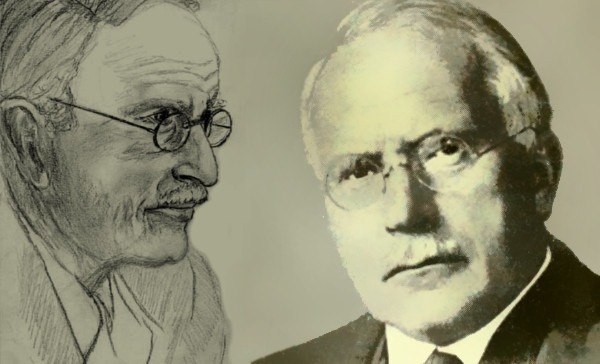
Psychiatrist and physician, he is regarded as one of the founding figures of depth psychology.
He developed analytical psychology alongside Freudian psychoanalysis.
His exploration of the psyche and the unconscious found a remarkable resonance with astrology, other so-called “esoteric” disciplines, and various ancient philosophical traditions.
Jung and His Psychological Work
Jung’s work and his contribution to the field of psychology are truly immense.
He partially built upon Freudian psychology, yet expanded its scope into dimensions of transcendence, both on an individual and a collective level, extending his vision to humanity as a whole.
Where Freud remained largely focused on the individual, linking psychology to early childhood experiences, Jung explored spirituality and everything that could constitute a common determinant shared by all of humanity.
This line of thought led, in part, to the foundational concepts of the collective unconscious and archetypes (notably Anima, Animus, and Shadow).
As ancestral psychic inheritances, Jungian archetypes form the cultural, biological, social, and religious “mortar” of the psyche.
They serve as essential components in the formation of individuality, the process of Individuation, and consequently in the structuring of human society and its ongoing evolution.
Jung developed much of his work around this concept of Individuation, understood as the emergence and integration of the individual personality beyond the collective and the ancestral forces it embodies, both culturally and morally.
It represents the foundation of the “I am”, the mystical inner marriage between the individual and the collective.
He took a deep interest in myths and religions, particularly Eastern traditions, drawing from them a source of inspiration that likely multiplied his creative output in psychological theory.
Among these influences are: The Secret of the Golden Flower, the I Ching, Yoga, Alchemy, and… astrology.
Jung is credited with developing the concept of Synchronicity, a fascinating phenomenon addressing the simultaneity of inner psychic events and external occurrences, and the meaningful analogies that arise from them.
Does this sound familiar ? It certainly sheds light on his interest in astrology.
Mysticism was one of the most significant points of divergence between Jung and Freud.
Jung viewed religious thought and symbolic myth as an integral part of human nature, a primordial instinct comparable to biological instincts, something to be cultivated or at least allowed to express itself, rather than merely a sublimation of sexual drives as proposed by Freudian theory.
From my perspective, it’s somewhat regrettable that Jung may have been partially constrained in his expression by the dominant scientific and rational mindset of his era.
This may seem paradoxical when speaking of such an iconoclastic figure, who already demonstrated remarkable reformative courage and a profoundly visionary spirit, far ahead of his time.
Yet one can only wonder what a Jung might have become a century later, in an era perhaps more receptive to his ideas (The same could be said of Einstein, or other extraordinary figures often described as “geniuses”).
The great astrologer Dane Rudhyar was deeply inspired by Jung’s work, depth psychology, and the development of personality, using these ideas to “reform” traditional astrology by giving it a more psychological and analytical foundation.
The two men shared many common traits in their understanding of humanity and mysticism, and it’s no surprise that the synthesis of their teachings has proven so rich for both disciplines: astrology and psychology.
Below is a selection from Jung’s bibliography that captures the essence of his teaching:
- “Psychological Types”
- “Psychology of the Unconscious”
- “Man and His Symbols / Modern Man in Search of a Soul”
- “The Soul and Life”
- “Synchronicity and Paracelsica”
- “Mysterium Coniunctionis and Volume 2”
- “Symbols of Transformation”
- “Psychology and Alchemy”
- “Commentary on The Secret of the Golden Flower”
- “The Psychology of Kundalini Yoga”
- “Psychic Energy”
- “Aion: Researches into the Phenomenology of the Self”
- “Two Essays on Analytical Psychology”
- “The Relations Between the Ego and the Unconscious”
- “Memories, Dreams, Reflections”
- View Jung’s full bibliography here
Birth Chart of Carl Gustav Jung

For Jung’s birth data, I rely on Dane Rudhyar’s book “Astrology of Personality”, which states that he was born in Kesswil, Switzerland, on July 26, 1875, with an Ascendant in the final degrees of Capricorn.
Some sources give a birth time of 7:20 p.m., others 7:30 p.m. or later; some also use BMT (Bern Mean Time, a local Swiss time zone that no longer exists) rather than GMT.
Given these uncertainties, I retain a third-decan Capricorn Ascendant (GMT) without specifying the exact degree, although the Aquarian influence remains significant, as we shall see.
Leo Sun with a Capricorn Ascendant, what determination, what drive to assert oneself, and what ambition for personal success, yet never without integrating a deep sense of social purpose and fulfillment through relationships.
Fire is strongly emphasized, both by sign and by house placement, followed by a dominance of fixed signs that greatly stabilize the personality, particularly in terms of outward expression.
Angular houses further underline the need for action and initiative, while a predominant Western hemisphere highlights family and social development.
Overall, the energies in this chart are fairly well balanced; some astrologers even classify it as a “star-shaped” chart, indicating both harmonious energy distribution and a certain inner tension or dispersion.
This Capricorn Ascendant plays a major role in the chart, with its ruler Saturn retrograde in the 1st House in Aquarius.
This placement underscores reserve, rigor, and introversion, essential traits of the personality, while simultaneously opening the mind to the collective, mature friendships, and to innovation or to the “extraordinary”.
This does not diminish the generosity and nobility of the Leo’s spirit Sun in the 7th House, but it likely intensified tendencies toward anxiety and stress.
Especially since this Saturn is strongly aspected:
- Trine to Jupiter at the Midheaven in Libra, in its own sign in the 9th House, supported by Mars sextile in Sagittarius in the 11th House
- Square to Pluto in Taurus in the 4th House, conjunct the IC
- A wide opposition to Uranus in Leo in the 7th House
- Square to the MC–IC axis
From this Saturnian rulership emerge several key themes: a need for structure, spiritual elevation, and collective fulfillment.
A strong dynamic supports this path, and Jung’s intellectual and philosophical positions were well-argued and persuasive.
Mars acts as a pivotal relay between Jovian and Saturnian energies (the two collective planets), further reinforced by the Black moon.
There is also a profound necessity to delve deeply into foundational roots (hereditary, cultural, and familial) and to question them in order to undergo irreversible transformation.
Relationships and social fulfillment act as a pivot between these roots and transcendence.
In truth, one could almost stop the analysis here, as Saturn’s rulership alone already speaks volumes in light of Jung’s biography.
The Moon in Taurus in the 4th House reinforces the Plutonian theme of questioning foundations.
Its square to Uranus in the 7th House, along with Neptune in Taurus squaring the Sun, further emphasizes the importance of inherited cultural and social foundations, while simultaneously challenging them through relationships.
This brings a certain volatility and impulsiveness, heightened sensitivity, and strong intuitive capacities.
This Moon also evokes a deeply domestic side, warmth in the home, benevolence toward women, and a maternal influence that must have been decisive.
Here we touch the more private and emotional dimension of the chart.
The heavily emphasized 4th House highlights the weight of family and cultural heritage (even karmic memory) and already contains the seeds of absolute values, idealism, and a form of utopian vision.
The Black moon in Sagittarius, conjunct the Midheaven in the 11th House, further confirms the importance of collective and philosophical factors in Jung’s destiny and social fulfillment, strongly reinforced by its opposition to Pluto conjunct the IC.
The Lunar Nodes refine this theme even further: the South Node in the 9th House reflects Jung’s innate moral and philosophical foundations, while the North Node in the 3rd House calls him to conceptualize transcendence, to explain it, and to make it accessible and practical for his environment.
This mirrors his work as a psychiatrist and his theorization of Individuation (with Chiron the Healer also conjunct the Nadir).
A brief word on his personal planets: Mercury and Venus in Cancer in the 6th House suggest dreaminess, sensitivity, deep family attachment, and meticulous dedication to work, along with strong memory and devotion to his societal mission.
This is also a zone of identity crisis, accompanied by nervous tension. Their sextile to the Moon provides valuable support for deepening and expanding the lunar themes described above.
Mercury turns retrograde by converse progression relatively early in life, returning to direct motion only around age 34.
This suggests a profound existential crisis that found resolution only at that age. Dane Rudhyar spoke of the “successive births of the human being”, with psychological and mental birth occurring around age 28.
When correlated with transits, especially Saturn’s cycle as chart ruler and its first return, the period between ages 28 and 34 must have been exceptionally rich in inner evolution for Jung.
Throughout his life, Jung relentlessly sought to go far beyond Freudian psychoanalysis and classical analytic frameworks, recognizing the transcendent dimensions of the human psyche and opening himself to the full mysticism of life. This is what made his work distinctive, successful, and enduringly relevant.
He must have deeply loved his work, perhaps even experiencing it less as a profession than as a true vocation, a calling to which he devoted his entire life.
I would like to share one of his most beautiful quotes, which perfectly reflects both his worldview and his approach to working with patients, and which resonates remarkably with his birth chart as analyzed above :
“The lack of meaning in life plays a crucial role in neurosis. Neurosis must ultimately be understood as the suffering of a soul that has not discovered its meaning… About a third of my patients suffer not from clinically definable neuroses, but from the meaninglessness and emptiness of their lives.”
And it must be said that matters have hardly improved since then. Psychological suffering has become pervasive in a society that consumes antidepressants and sleeping pills like candy, while giving little collective attention to the question of meaning.
It’s essential here to emphasize the need for a “TRUE meaning” and a “TRUE purpose”, not substitutes that merely divert energy, pale palliatives that struggle to prevent individuals from sinking, sometimes even into Depression.
This is precisely what Jung sought to convey through the principle of Individuation: a process of self-realization, not necessarily an absolute requirement for everyone, but a potential path to follow, or more accurately, the needle of a compass pointing us toward the right direction.
To go further: