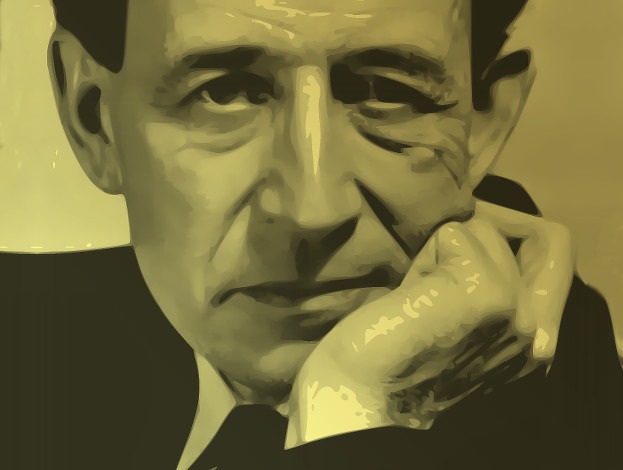
Musician, painter, philosopher endowed with remarkable intellectual subtlety and genuine analytical depth, a keen observer of human psychology, and… a great astrologer.
Dane Rudhyar and his astrological work
Born on March 23, 1895, in Paris and deceased on September 13, 1985, Dane Rudhyar unquestionably left a profound mark on 20th-century modern astrology by “clearing the dust” from traditional astrology, especially by re-centering it around the notion of cycles.
He brought astrology closer to the human sciences, particularly humanistic psychology and depth psychology, notably through the work of Carl Gustav Jung. From this synthesis emerged what he would later call “humanistic astrology” or “transpersonal astrology”, an astrology devoted primarily to personal development, rather than fortune-telling or predictive sensationalism.
Rudhyar broke away from superstition, from the simplistic notions of “good aspects” and “bad planets”, restoring astrology to a less dualistic, more psychologically nuanced perspective, closer to the true richness of life itself.
I am often asked: where should one begin when studying astrology ?
It’s a far more subtle question than it may appear.
While basic astrological principles can be learned from countless books or teachers, the true foundations of astrology, both technical and philosophical, are often found elsewhere (with true Masters) and especially in the teachings of Dane Rudhyar.
If you are genuinely interested in astrology, you must read Dane Rudhyar.
His works are not always easy to approach, but they are more than worth the time and effort they demand.
If you appreciate astrology and are not yet familiar with Rudhyar’s work, do not hesitate.
Which Rudhyar book should you start with ?
That depends on your existing foundations and what you wish to deepen.
Here is his main astrological bibliography :
- “The Rhythm of the Zodiac”
- “The Astrological Houses”
- “Astrological Aspects: A Process-Oriented Approach” with Leila Rael
- “Astrological Triptych”
- “The Astrology of Personality”
- “An Astrological Approach to Psychological Complexes”
- “Astrology and the Modern Psyche”
- “The Lunation Cycle”
- “The Practice of Astrology”
- “The Sabian Symbols: The Meaning of the 360 Degrees of the Zodiac”
- “Astrology of Transformation: A Multidimensional Approach”
- “The Seed Man or the New Spirituality”
- “Crisis and Creativity”
- “The Galactic Dimension of Astrology: The Sun Is Also a Star”
- “History in the Rhythm of the Cosmos – Humanistic Astrology”
- “A New Man for a New Age”
- “The Rhythm of Wholeness”
- “Toward a Planetary Consciousness”
I would personally recommend starting with his foundational astrological works (Signs, Houses, Aspects…).
His book on the Houses is particularly accessible even to beginners.
That said, reading his books in the chronological order in which he wrote them is also highly relevant, as it allows one to follow the evolution of his own thinking.
As for me, I discovered Dane Rudhyar’s work through “Astrological Aspects – A Process-Oriented Approach”.
It’s not the easiest entry point, but it’s a brilliant and visionary book.
I was deeply struck by both the precision of his descriptions of cyclical processes and the philosophical depth he draws from every page.
This was the starting point of a thorough study of Rudhyar’s work : The Astrology of Personality, An Astrological Approach to Psychological Complexes, The Lunation Cycle, The Practice of Astrology, Astrological Triptych, Astrology and the Modern Psyche, and many others.
I filled pages of notes for each book, notes which in turn led me toward further research.
Dane Rudhyar possessed an exceptionally rich mind that naturally invites continued exploration and deepening.
Rather than merely decoding the “algebra” of astrology, he consistently pushed beyond it.
He sought to make us reflect on astrology’s global mechanisms and underlying dynamics, in a way that was both philosophical and playful.
He masterfully reconciled attention to detail with a broader, more holistic vision, a term he himself popularized, combining a mental and a metaphysical approach.
Rarely have I encountered an author so consistently captivating.
Each of his books brings genuine depth and insight.
Even when addressing astrological themes that might appear “well-known”, he offers a transcendent and highly relevant perspective, his own.
In short, if you are interested in astrology, you must read Dane Rudhyar.
If I were to point out a weakness, the book I appreciated the least is “Toward a Planetary Consciousness”. Not because it lacks relevance, but because I personally felt I learned little that was truly new.
Rudhyar revisits ideas already explored in his other works, and certain passages tend to drift (or risk drifting) toward purely political, universalist notions.
To my mind, astrology should primarily remain within the philosophical realm.
That said, I understand how these ideas arose logically from his worldview.
On an abstract, long-term level, why not, but in daily pragmatic reality ?
One must also remember that he belonged to a generation deeply marked by both World Wars and by the advent of nuclear power.
This context likely explains much of his thinking, similar to that of Einstein and others of the same era, including slightly younger astrologers.
Likewise, I never fully understood his rejection of equal-house systems. I regret that he did not elaborate more on this subject, as I would have appreciated a deeper explanation of his reasoning.
Birth chart of Dane Rudhyar
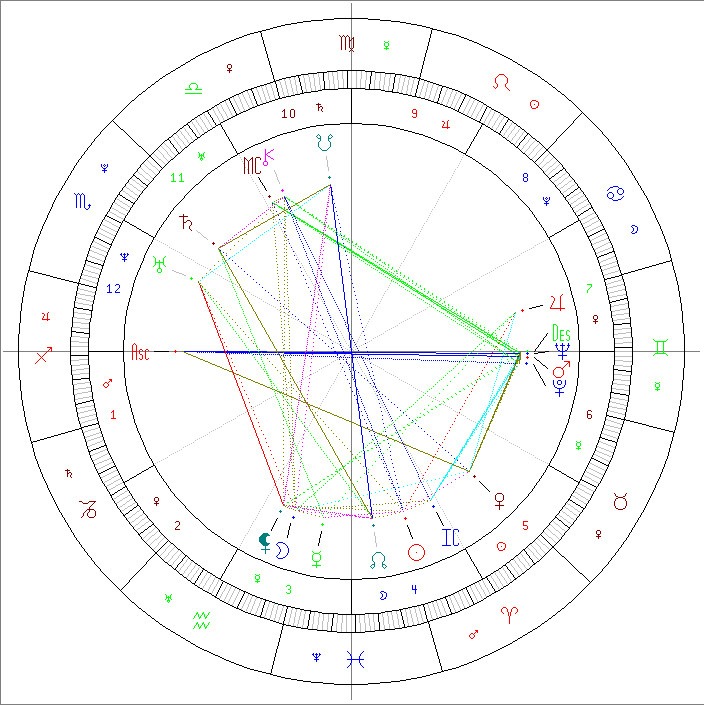
I use Rudhyar’s own birth data: March 23, 1895, in Paris. Regarding the birth time, he himself stated that his Ascendant was at 14° Sagittarius, which places his birth at approximately 1:34 a.m.
Aries Sun, Sagittarius Ascendant, a combination of initiative, risk-taking, and metaphysical questing, reinforced by a strong emphasis on mutable signs.
Aside from a Fire-emphasized Venus (Aries, 5th House), which may explain both the value he placed on creativity and his pronounced artistic tastes, the chart is predominantly Air, with some Water.
Such an Air emphasis reflects remarkable mental agility, erudition, and highly conceptualized thinking.
Gemini on the Descendant hosts no fewer than four planets, including a triple conjunction of Pluto, Neptune, and Mars (ruler of the Sun).
This configuration is not inherently “negative”, especially as it forms no major dissonant aspects elsewhere, but it was likely not easy to live with.
It suggests great sensitivity, intensity, depth, and even instability, one of the first things that stands out in his chart.
It may have affected his health, relationships, and emotional life, particularly with Neptune tightly conjunct Mars and the Descendant, evoking possible projection dynamics onto moral or philosophical ideals.
However, trines to the Midheaven suggest a sublimation of these energies through social expression or professional vocation, a constructive and harmonious use of these forces.
It’s also noteworthy that this triple conjunction is framed by Jupiter and Venus.
Jupiter (ruler of the Ascendant) though in detriment, may have softened the 7th House by bringing warmth, enthusiasm, and a philosophical desire to help others. A waning square to the Sun suggests that Rudhyar may have struggled to assert himself in relationships, sometimes forcing himself forward, with potential legal or associative conflicts.
In trine to Jupiter is the Moon in Aquarius, in the last quarter phase of the lunation cycle, a phase of integration, evaluation, and “seed formation”, as Rudhyar himself described it.
Childhood may have been solitary or inward-focused, marked by dreaminess and escapism, yet deeply formative.
The Moon places sensitivity and imagination in service of the collective, reflecting altruism and a strong need for intellectual freedom.
Placed in the 3rd House, this further confirms his drive to channel these energies into communication, intellect, and the fertilization of his environment.
The Moon is conjunct the Black moon, underscoring the Moon’s central role as both foundation and life objective.
A trine to Pluto in the 6th House suggests profound analytical ability, even in a therapeutic or psychoanalytical sense.
The Black moon forms a trine to Gemini energies but a tight square to exalted Uranus in Scorpio.
Retrograde Uranus in the 12th House likely pushed him toward introspection, mysticism, and transcendence, conferring visionary, even mediumistic, qualities. The square indicates existential tension, a crisis-driven dynamic calling him toward the fulfillment of his social vocation.
Uranus and Mercury frame the Moon/Black moon conjunction.
Retrograde Saturn in Scorpio in the 11th House likely helped structure these Uranian energies.
Both planets are ruled by Pluto, acting as both antenna and safeguard.
This Saturn probably allowed him to stabilize and channel his fiery cardinal Aries impulses, made him selective in friendships, and enabled him to give concrete form to the monumental body of work he left to posterity.
The lunar nodes lie close to the zenith/nadir axis, with the North Node in the 4th House, highlighting a deep need for inner grounding.
Rudhyar himself referred to the nadir as the “center of the Earth”, the ultimate center of being.
This axis emphasizes heritage, tradition, and the idea that social realization must serve inner foundations.
Dane Rudhyar possessed powerful energies of action and self-assertion in his birth chart, enabling him not only to overcome difficulties but to transcend them, supported by a strong social awareness.
He first sought to affirm his unique individuality and build everything upon that experience, later evolving toward more collective, even philanthropic goals.
The Sagittarius Ascendant and the strongly emphasized Gemini axis were clearly decisive, pointing to a vocation centered on analysis, abstraction, and conceptual thought in service of metaphysical knowledge.
Rudhyar once said of Jung that he was a “great personality who had reached a creative stage”, a “seed form” attaining a form of immortality by disseminating his vision into future generations.
The same can be said of him. Dane Rudhyar reached and transcended that creative stage. He integrated traditional astrology, transformed it, and expanded it by incorporating discoveries from all fields of human and scientific knowledge.
Jung’s depth psychology was undoubtedly one of the most significant contributions to this synthesis.
Dane Rudhyar was to astrology what Carl Gustav Jung was to psychology.
His only “fault”, in the eyes of conventional society, was to defend the ostracized human science known as astrology.
It is unjust that he remains relatively unknown, yet time ultimately vindicates the just.
The seeds he planted have surely not finished germinating in future minds.
Dane Rudhyar was a visionary mystical philosopher before being an astrologer. Astrology was merely the tool through which he expressed this vision, a rich, profound, and extraordinary expression.
To go further: