In humanistic astrology, the notion of understanding the global astrological cycle is truly central.
From this concept of cycle naturally arises the notion of Aspects, and therefore very directly both the interpretations that can be drawn from them (harmonic or dissonant dynamics), and even the entire body of knowledge related to evolutionary patterns operating within the personality (cycles simply describing the timing through which these patterns unfold).
At the archetypal level, the cycle taken as the most obvious and fundamental reference point is the soli-lunar cycle, our well-known “lunation”.
It is most likely the very first astrological cycle that human beings studied in depth since the dawn of time.
It is the cycle with which we are most familiar, and at the same time it carries a very strong archetypal charge.
Through a solid understanding of its main generic stages, one can extrapolate and understand any other planetary cycle, within the triangular relationship of “planet–Earth / Sun / transiting planet”…
It is no coincidence that astrologer Dane Rudhyar devoted an entire book to it (named “The Lunation Cycle”), as did Alexander Ruperti (named “The Many Faces of the Moon”).
There is so much to be said about this cycle, and these works remain, even today, the foundational references of humanistic astrology on the subject.
There are thus three major axes for understanding the lunar cycle: as a general evolutionary cycle, as an interpretive factor within the birth chart, and as a temporal process shaping and expressing itself through present-day experiences and realizations.
It can therefore be approached as follows:
1. First, for what it represents at a generic level, as an archetypal cycle
2. Then, by understanding that the lunation phase present at birth and imprinted in the birth chart has a significant impact on the overall interpretation of the chart
3. And finally, by understanding that from this initial natal lunation phase will unfold the entire progressed lunation cycle that we experience in the present, describing our subjective psychic growth, and offering key insights to be cross-referenced with transit cycles

1) The lunation as a generic archetypal cycle
This soli-lunar cycle serves as a basis for studying Astrological Aspects: the relationships that can form between two planetary functions, and the way we analyze and interpret them.
It allows us to understand what can be inferred from the link established between the faster-moving planet and the slower one, in increasing order:
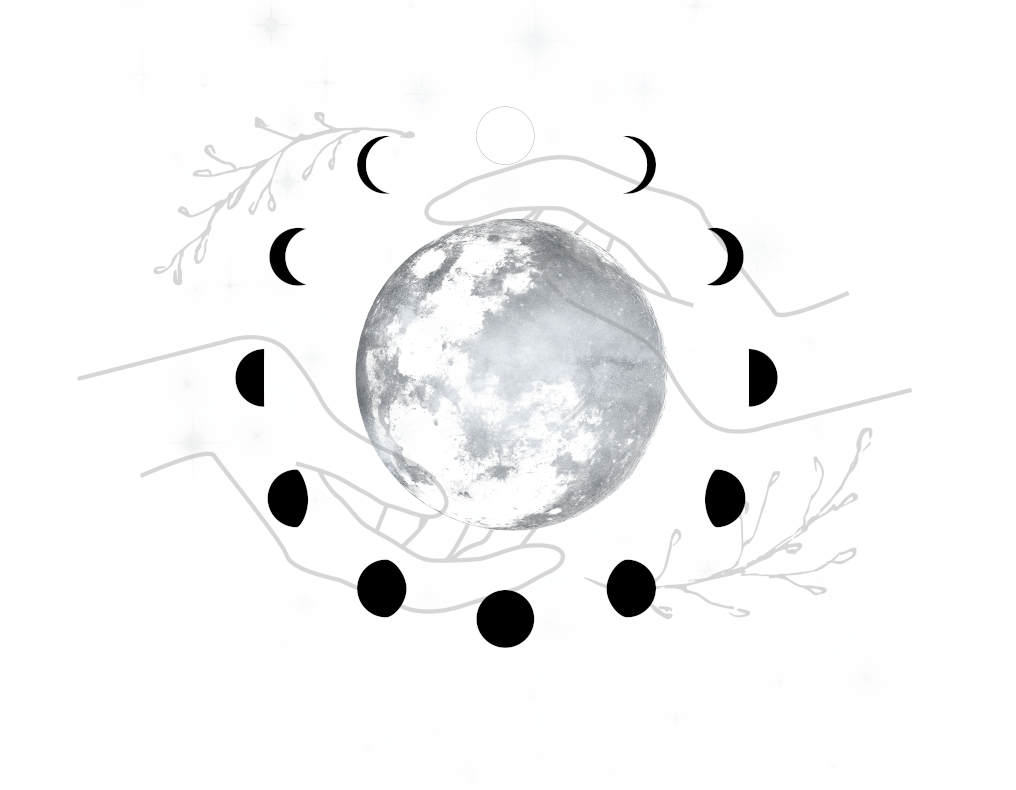
* First, the root aspect, the Sun/Moon Conjunction: the New Moon (appearing as a black circle on the calendar)
This phase corresponds to a new beginning lasting nearly a month.
It calls for initiating something new and taking action.
It requires both cutting ties with the previous lunation and planting new seeds in order to express one’s potential.
This is the phase generally chosen to set New Moon intentions, to refocus on our essential goals and take advantage of this initial impulse…
* The waxing crescent: equivalent to the waxing Semi-sextile, the first step away from the harmony of the conjunction.
This is the first surge of momentum, when energy is still fresh, dynamics are strong, and force is at its peak.
It is time to be bold and to break inertia and the status quo…
* The First Quarter, equivalent to the waxing Square
This is the first major test of the cycle. A tension or challenge must be overcome, requiring effort and determination to confirm the commitment initiated at the New Moon, so that the forces involved can be sustained throughout the rest of the cycle.
* The gibbous Moon: the waxing Quincunx phase, just before the important Full Moon stage.
The Moon is highly charged, more nervous, impatient, volatile, and changeable.
It is, in a sense, in a preparatory phase for what is about to be brought into the light, and must therefore adjust and refine the final details, maximizing its strengths…
* The Full Moon, positioned in Opposition to the New Moon, corresponding to a phase of illumination within the cycle (the peak of the waxing phase, appearing as a white circle on the calendar).
What was seeded at the conjunction now reaches a form of flowering or culmination.
This can correspond to tangible achievements, revelations, moments of awareness, public exposure, or the presentation of a project to others…
* The disseminating Moon: the waning Quincunx phase
The cycle now operates based on the power of the Full Moon, which becomes the new short-term reference point.
What was illuminated at the Full Moon must now be integrated, cultivated, and more broadly shared throughout the second half of the cycle. At the same time, one must begin to detach from these achievements, no longer identify with them, and gradually accept this turning point in the cycle.
* The Last Quarter, equivalent to the waning Square
Once again, the cycle presents a challenge, this time related to integrating the forces that have been mobilized throughout the entire process.
There is a symbolic struggle to determine what should be retained from this lunation, and what should instead be allowed to dissolve on its own or be consciously released.
This phase calls for taking stock of the entire cycle and finding balance in what must be preserved.
* The balsamic Moon, equivalent to the waning Semi-sextile, marks the end of the lunation cycle. There is a strong emphasis on review and recapitulation as the next New Moon approaches.
As the cycle draws to a close, this phase calls for letting go, accepting, and detaching from what has been accomplished.
It is truly like the image of a long-distance runner about to cross the finish line: the entire race now lies behind them, nothing more can be changed or improved, and they are faced with the outcome of the cycle and of their actions : the realization of success or failure.
2) Which lunar phase was I born under ?
This is a very fast cycle, unfolding over approximately 28 days. The Moon moves quickly, changing zodiac signs almost every two and a half days.
As a result, its progression through the sky plays a major role in “stamping” the personality and individuality.
In contrast to the more generational influences of the slow-moving planets, the Moon operates on a highly individual level, differentiating us profoundly from one another, and doing so very rapidly.
As Dane Rudhyar explains, the lunation phase under which we were born, and its specific Sun–Moon angular relationship, tends to have a very direct influence on our behavior, temperament, and ultimately our destiny.
Whether we are born during the waxing or waning phase of the cycle already provides valuable clues, often indicating a tendency toward extraversion or introversion.
In reality, the specific characteristics of each phase described above tend to reproduce themselves in the personality and life path, each phase containing within it the seed of its own evolutionary pattern.
Dane Rudhyar also strongly recommends analyzing the New Moon immediately preceding our birth, as it constitutes the “root aspect” of the entire lunation present at birth.
This prenatal New Moon imprints its influence on the whole lunation under which we were born, often with broader repercussions than one might expect, even though it occurred before birth (it can also be found in converse progressions).
Naturally, lunation phases can also reflect the way the parental couple expressed itself during our childhood, and whether the Animus / Anima dynamic was experienced as more harmonious or more tense.
Whether harmony or tension prevails between the Sun and Moon at birth is a fundamental marker of individuality.
A tension between the luminaries always represents a major “challenge” of incarnation.
3) The progressed lunation cycle: understanding our current psychic evolution and its unfolding
Depending on the lunar phase at birth, a very specific evolutionary pattern is imprinted, along with a precise timeline that unfolds from the moment we enter the world.
This creates periods in life during which we are called to experience particular phases of the progressed lunation cycle.
The progressed Moon continues its journey from birth onward, marking successive phases at its own rhythm, activating natal planets and houses.
This results in highly individualized forms of actualization.
It describes a personal temporal framework unique to each of us.
Our progressed lunation phases shape our evolutionary pattern, particularly in how we subjectively experience inner processes.
The progressed Moon is the fastest-moving body in secondary progressions, and it sets the most refined rhythm of the present moment.
For this reason, it is especially important to track.
Its relationships with the Sun (both the natal Sun and the progressed Sun) serve as reference points for the progressed lunation cycle and therefore require close attention and careful analysis.
For example, a progressed New Moon conjunct the natal Sun always marks a major life period: an important turning point, a moment of awareness, a revelation, a metamorphosis, and so on.
Ultimately, all of this knowledge flows directly from an understanding of the lunation cycle.
This is why it represents one of the very first foundations to be mastered in the study of astrology…