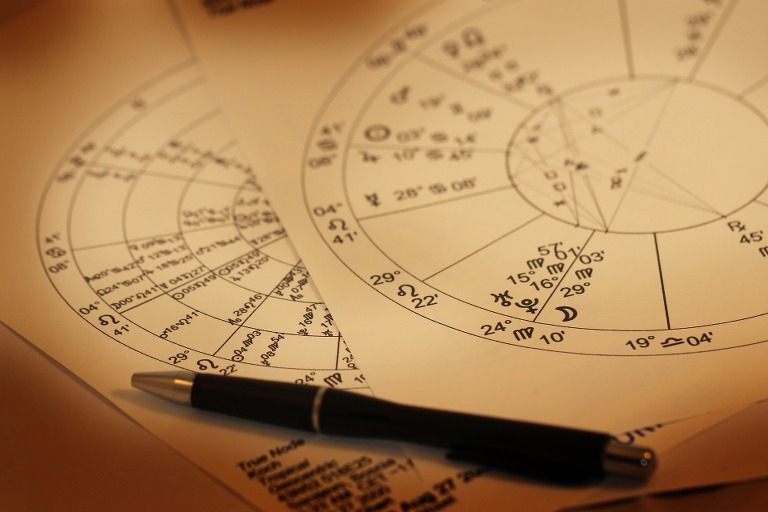
With divinatory astrology, also known as “horary astrology” or “the astrology of questions”, we are entering the most esoteric part of astrology.
It is often misunderstood, moreover by some astrologers themselves, who imagine it to be “less respectable” because it is less “scientific”, and therefore distance themselves from it without seeking to understand it further, unfortunately…
It is true that horary astrology is probably the branch of astrology that has given rise to the maintenance of the greatest number of “superstitions”, insofar as it genuinely resembles a “divinatory” practice in its approach, and even, in certain respects, an apparently “fatalistic determinism”.
Below you will find some rules and practical tips for the interpretation of horary charts and questions… but there are a great many techniques, subtleties, and variations.
Therefore, if this subject interests you and you wish to practise it, I strongly recommend studying the specialized books on the subject.
What Is a Horary Chart ?
Let us be clear: horary astrology is closely related to other oracular occult practices, such as an I Ching reading, or a tarot reading, and therefore to divination.
In this respect, it’s probably the oldest form of astrology, as it truly approaches an “empirical” analysis of energies and, moreover, does not require birth data, which is one of its major advantages.
A horary question casts an astrological chart for a specific “instant” in order to better define a problem or clarify a situation.
This chart and its interpretation indicate probable consequences and conclusions, as well as potential timing, and the time required for events to unfold; it is therefore a potentially powerful tool.
The analysis and interpretation of a horary chart differ from those of a birth chart, but its fundamental principles remain the same as those of other branches of traditional astrology: analogy and synchronicity.
Schematically, in horary astrology, it is assumed that the planetary energies present at the moment a question is asked (or at the moment an action is undertaken) “crystallize” the fundamental reality of the matter in question (like an instantaneous snapshot), both the visible realities and the more underlying ones.
The chart must therefore be analysed accordingly, in a specific manner.
Horary astrology reveals the “vibrations” surrounding a period, an event, a precise moment…
In this sense, it’s essentially a transit chart, but one whose interpretation, rather than being focused purely on planetary energies and their psychological natures, requires an in-depth analysis of the Houses and their Rulerships in order to discern their modes of expression.
Where a purely humanistic astrologer stops within the psychological and psychic sphere of the fundamental “why ?” (which is already considerable), horary astrology attempts to answer the “how ?”.
Horary astrology can quickly become extremely rich and complex when the technique of derived houses is added: each house can become the new starting point for twelve additional houses, bringing the total number of possible house combinations to 144… Generally, this is also where many astrologers become “lost”. 😉
However, without necessarily engaging in extremely advanced analyses of derived houses (which are not always strictly necessary), horary questions are often remarkable for the additional details they can provide, which is precisely why I retain them.
Some astrologers, such as Hadès (french astrologer), even recommend, in certain cases, the sole use of the horary chart.
However, even though the horary chart is reliable in itself, its analyses must, in my view, systematically and imperatively be cross-checked with other forecasting techniques (birth chart, solar and lunar returns, Progressions, Transits, etc.).
This is more time-consuming and demanding, but also more precise.
This is especially true in the context of a horary election (the choice of a precise moment, the determination of a period), where one must take into account at least the birth chart, the solar return, the lunar returns, the transits, and the New moon, correlated according to the domain of the question and the objective of the election.
I do not, strictly speaking, offer “pure horary astrology consultations”.
I do not always mention it directly in my analyses, or only sparingly (as it is complex to grasp and explain, especially for people who are not initiated or familiar with traditional astrology), but I use it very regularly, and certain analyses are genuinely relevant for refining a humanistic astrological interpretation.
The astrology of questions possesses a certain boldness in its principles and approaches, and often an extended, surprising, and perceptive precision.
The horary chart can make it possible to assess more finely all the potentialities contained within the birth chart, but it does not replace it in the evaluation of psychological character and “destiny”.
Without any birth time or birth date, divinatory astrology makes it possible to answer precise questions that would not necessarily be accessible otherwise. The only requirement is that the question has a “significant hold” on the client’s mind…
Asking a Question in Horary Astrology
There are several strict rules governing the way a horary question is asked and interpreted.
The first, and undoubtedly the most important, is the determination of the “appropriate moment in the sky”.
It is the specific vibrations of that moment which, through synchronicity, “imprint” the astrological analogies within the chart that will best answer the question asked.
If the moment is “poorly chosen”, the chart’s answer will not be meaningful (see below in particular the cases of non-valid horary charts).
Which moment and which place should be retained ?
- either the moment when the question arises in the mind of the querent
- or the moment when the astrologer becomes aware of it
- either the location of the querent or that of the astrologer
- or the place and location directly related to the question (for example: “I am attending a meeting, on a given day, at a given time, in a given place : how will it unfold ?”)
I generally favour the moment and the place at which I become aware of the question, except in specific cases.
In reality, we speak of a “choice of moment”, but in certain respects, it is rather the moment of the question that imposes itself upon us.
Through synchronicity, the planets “urge” us to question; they “trigger” this interrogative movement of the mind.
It is the instant that commands the question.
It is therefore this precise “instant” that matters, which must be identified and analysed.
Robert Ambelain, in his book “The Astrology of Questions”, speaks of a “fury animating the mind”, that is to say, “a vivid impulse, a powerful desire, a sudden and irresistible urge to know an answer”.
It is a movement of the soul that generates this “thirst”, that fuels this inner motivation, and this profound need for guidance must not be confused with a vague appetite for superficial curiosity.
One must therefore be facing a real problem and possess a serious desire to find a sincere solution.
Typically, the most frequent questions revolve around matters of health (illness, accidents), romantic difficulties (marriage, flirtation, separation), future projects (professional, financial, leisure-related, travel…), but they may also concern the analysis of an obscure situation from the past.
A horary chart can answer only one question.
It may be useful to break down the main question into sub-questions in order to refine the approach, but this must always be done on the sole basis of the primary question and the same chart (notably through the use of derived houses).
Knowing how to define and properly formulate the question is another important step.
A clear question is required if one wishes to obtain a clear answer.
The question must implicitly contain an idea of the consequences it raises, and there must be at least a minimal link with the querent.
If the horary chart is interpretable, what types of answers can be expected ?
Schematically, 3 scenarios may arise :
- “Yes”: the chart confirms the nature of the request and responds by providing details
- “No”: the chart indicates a negative answer and provides certain clarifications
- “Indeterminate”: the chart is interpretable but only partially; the significators are balanced within the chart, in which case the question is not decisively resolved:
- either there is a perfect equilibrium, making it impossible to determine an answer,
- or unforeseen elements may tip the balance at the very last moment,
- or, for reasons that transcend us, the querent is not meant to know the detailed answer to this question at that specific time…
One should never ask the oracle the same question again if the first chart has already provided an answer, whether that answer is satisfactory or not.
If further clarification or a different analytical perspective is required, the horary chart that has already been cast contains, in germinal form, all the elements needed to understand both the issue and its answer.
A horary question may only be asked again if the situation itself evolves, resulting in a modification of the original question.
In that case, a new and different question must be reformulated according to the new circumstances.
“Can horary astrology be used for anything and everything ?”
Although tradition grants horary charts a very wide range of prerogatives (in fact, almost any question can be asked), I strongly advise against using them indiscriminately, as this is not a game.
Horary astrology is not intended to answer questions for which one can easily find the answer oneself, or which are entirely trivial.
The astrology of questions should be reserved for pivotal periods, in order to obtain details concerning key elements, where other techniques of traditional astrology (birth chart, forecasting techniques…) cannot be useful or can no longer provide additional indications.
For example, to a question such as “What types of profession am I suited for ?”, a birth chart analysis will be far more appropriate.
It will allow the astrologer to determine character traits and the different psychological facets of the personality (sub-personalities), including repressed ones, and will provide a developmental axis for the personality…
Astrological forecasting techniques or a karmic study may then complement the analysis and provide a chronology for the fulfilment of natal potential.
In another example, if an element has been identified in the solar return and is subsequently confirmed in a lunar return of the year, a horary chart may then provide additional, more precise details.
Divinatory astrology, like any divinatory practice, is somewhat like a hiker’s compass : one does not keep one’s eyes fixed on it while walking.
One secures each step, enjoys the landscape, meets others, and then, from time to time, checks the map and compass to ensure the right direction, nothing more. After that, the compass is put away again, in order to continue enjoying the journey…
Special cases: when a horary chart cannot be interpreted
For a horary chart to be interpretable, it is absolutely essential that it accurately reflects the question.
The significators (of the client and of the matter asked about) at the moment the question is asked must correspond to and clearly describe the object of the question.
A chart is therefore considered validly interpretable when there is a clear analogical correspondence or any form of actual contact between :
- the significators of the querent (the Moon, the ruler(s) by domicile and exaltation of the 1st House, and any planet(s) occupying it)
- and the significators of the question (the ruler(s) by domicile and exaltation of the main house of the question, and any planet(s) occupying it).
This connection may be established in various ways: mutual or partial reception, aspects, etc.
A simple analogical correspondence without direct contact may merely indicate a negative answer.
Various factors may invalidate the possibility of interpretation:
- if the chart does not reflect the issue raised by the question at all
- if the Ascendant falls in the first three degrees of a sign, it is too early; the matter is not yet ripe and will require time.
The question should be asked again later, though not before the next lunation (it is sometimes possible to attempt an estimate of a more favorable period using predictive techniques) - if the Ascendant falls in the last three degrees of a sign, it is too late; the event is already reaching its conclusion
- likewise, if the Moon is at the end of a sign and makes no aspect, it may indicate the end of the sequence of events related to the issue; the matter is about to be resolved in an indirect way that the client cannot anticipate (positively or negatively)
- if some significators are retrograde or poorly placed, the interpretation may be distorted
- depending on the placement of the sign Scorpio, caution is required with interpretations directly derived from it
- similarly, the placement of the Lunar Nodes may indicate disturbance and confusion (or deception) and can invalidate an interpretation
- in certain cases, the placement of the “malefics” Saturn and Mars, if conjunct the Ascendant or the significators of the question, can complicate interpretation, as they lose their malefic quality and provide no additional meaningful indication (the rest of the chart must still be examined)
- the placement of the Black moon should also be checked, as it may indicate an ending and a renewal
Sources of error preventing interpretation may originate from the querent, the astrologer, or the planets themselves, resulting in a horary chart that is uninterpretable or misleading due to excessive complexity.
Several possible causes include:
- the moment and place chosen for casting the chart were incorrectly selected (the vibrations of the moment do not reflect reality)
- at the time of the question, the client’s mental state was insufficiently clear (fear, anger, anxiety, confusion, alcohol, drugs, illness); in such cases, the chart may appear excessively “negative” and merely reflect that state of mind.
It is preferable to wait until disturbing emotions have subsided before asking a question - the client was actually focused on a different issue than the one explicitly asked at the time of the question
- the question is poorly formulated or does not address the core of the issue
- several questions are embedded within a single query
- the question is unfounded: the client assumes an event will occur with certainty when it will not.
In such cases, the chart may effectively indicate that the question is “void”, as the client’s life direction will evolve in a completely different way than implied by the original question - the client lacks genuine motivation to know the answer and approaches the consultation with frivolity, superficiality, or mockery
- the client has already received an answer from a previous horary chart, found it unsatisfactory, and asks the same question again
- the matter depends exclusively on the client’s free will
- the client seeks to manipulate the outcome, and/or the astrologer himself:
- by attempting to alter the so-called “moment of the question”,
- by lying directly or through omission,
- by distorting the question: asking a secondary question in the hope that the answer will indirectly clarify another, more fundamental issue in the client’s mind
- mysterious reasons or unknown factors: the heavens oppose disclosure, resisting investigation; the client is not meant to know the answer
In all of the above cases, the chart will either not be interpretable, or its interpretation will address a different issue than the one asked, or its analysis will inevitably lead to errors.
If the horary chart appears excessively incoherent, it’s not valid.
One should wait for the situation to evolve, ideally at least until the next New moon, and then attempt a new horary question, preferably during the waxing Moon, and if possible reformulating the question in light of any new developments in the matter.
Rules for interpreting a horary chart
The rules for interpreting a horary chart are specific and in many respects quite different from those used in natal astrology.
The client, or the person who has the greatest interest in the answer, is signified by:
- the Ascendant and the 1st House,
- the ruler(s) of the Ascendant and of the 1st house,
- the planets located in the 1st house,
- as well as the Moon.
However, the Moon represents the object of the question and the answer more than it truly represents the client.
The sign Cancer and the house it rules should also be examined, as they may be significant.
The question is signified by the house that is most closely related by analogy to its purpose, by its ruler, and by the planets occupying that house.
Rulerships are of paramount importance. They are considered by domicile and by exaltation. Likewise, debilities are considered by fall and detriment.
The rulership of a planet overrides its natural nature; for example, benefic Jupiter ruling the 8th House (“malefic”) will indeed become the “malefic” significator of that house.
Retrograde motion overrides rulership; for example, a planet strong in domicile, even a benefic one, but retrograde, may become unfavorable or at least weaken the expression of its qualities (indicating delays or limitations).
Planets, natural and accidental significators
In divinatory astrology, each planet is a natural significator according to its own energy, traditional meaning, and analogical correspondences, with only minor variations:
- Sun: radiance, individuality, vitality, source of energy, will, honor, and visibility
- Mercury: communication, sociability, circulation, movement, mental, intellectual, and commercial activities
- Venus (“benefic”): our system of values and attraction, affection, and love
- Mars (“malefic”): action, desire, impulse, motivation, conflict, and by extension aggression, accidents, violence, and blood
- Jupiter (“benefic”): social expansion, professional and financial success, everything that tends toward “inflation”, spirituality, and it also signifies children
- Saturn (“malefic”): structure, delays, limitations, wisdom, rigor, seriousness, and by extension real estate
- the two Lunar Nodes are “malefic”; they indicate an added karmic burden, disturb the areas they occupy, and prevent a precise evaluation of their action
If the ruler or one of the significators of the client or of the question is a natural “malefic”, it loses its malefic nature de facto (and this may be a cause of invalidity of the chart; see above).
Should trans-Saturnian planets, the Black moon, or other asteroids be used ?
In the tradition, Uranus, Neptune, Pluto, and asteroids were unknown and therefore not used; astrologers based their interpretations solely on the septenary, and they did very well with it.
The septenary is the fundamental basis; the trans-Saturnians indicate transcendent factors and may be considered as complementary indications (like asteroids).
The Black moon, like the Nodes, is “malefic” and indicates a karmic charge, an ending and/or a renewal.
Some astrologers use the Arabic Parts, notably by studying the position of the Part of Fortune.
The astrologer Hades does not use it and advises against it in the casting of a horary chart, as he says, “each additional symbol multiplies the risk of error”; I fully agree.
One may glance at it out of curiosity, examine its contacts, but I set aside all other Arabic Parts, as well as the fixed stars.
Which house for the question ?
What is difficult and relatively complex is the determination of the house and the accidental significators of the question; this is largely where errors and misinterpretations can arise when the question is complex.
Tradition assigns different strengths to the houses depending on their type:
- angular houses are strong (1, 4, 7, 10)
- succedent houses are stable (2, 5, 8, 11)
- cadent houses are weak (3, 6, 9, 12)
The houses also have their traditional meanings in analogical correspondence, with some nuances:
- 1st House (“benefic”): the client, or the person with the greatest interest in the answer
- 2nd House : matters relating to possessions and acquisitions, money, income, material goods, finances
- 3rd House : matters of communication, studies, short journeys, letters, books, commerce, siblings
- 4th House : matters of family, home, real estate, private life, inheritance, and the ultimate outcome of things
- 5th House (“benefic”): matters of love (passion, flirtation, or illicit affairs), children, creation or creativity, will, personal projects and goals, pleasures, speculation, gambling
- 6th House (“malefic”): daily work, health and illness (acute conditions), employees
- 7th House : confrontation, partnerships, marriage, contracts, negotiations, aggression, theft, the adversary, all declared enemies; this house is very often of major importance in horary astrology
- 8th House (“malefic”): crises, deep transformations, death, inheritances, lawsuits, shared finances, taxes, changes in illness, sexuality, hidden matters
- 9th House (“benefic”): spirituality, luck, long journeys, higher education, philosophy, honesty (moral and legal), expansion, foreign matters
- 10th House : social and professional achievement, power, reputation, resolution of the situation; by extension the judge, the court, the employer, authority, management
- 11th House : friends, protectors, the lawyer, wishes and hopes, collective projects and goals, clientele
- 12th House (“malefic”): ordeals, solitude, health (chronic conditions), hospitalization, imprisonment, secrets, debts and losses, hidden enemies
The notions of “benefic” and “malefic”, whether for planets or houses, must be assessed intelligently according to the question, not taken literally.
Derived houses are commonly used; for example, if the horary question concerns the client’s brother, the cusp of the 3rd house should be used to rebuild a horary chart placing it on the Ascendant, and the interpretation carried out accordingly.
The astrologer Hades considers houses beyond the cusps and respects the signs. For example, if the cusp of the 2nd house begins at 10° Aries, he considers those first 10 degrees of the sign as belonging to the 2nd house in terms of influence.
Likewise, the entirety of the signs occupying a house must be taken into account for rulerships; for example, if a house contains Sagittarius and Capricorn, its rulers will be Jupiter and Saturn by domicile, and Mars by exaltation.
Indications of a favorable answer:
- if the significators form favorable aspects, this is a positive omen; the nature of the aspect must be studied (Conjunction, Trine, Sextile, Semi-sextile), mutual reception, applying (indicating reunion) or separating (indicating separation), as well as chronology and timing (see below)
- if there is “translation of light“: a planet placed between the significators separates from one and applies to the other, becoming the mediating factor, which may manifest through a third person
- if there is “collection of light“: the significators have no direct aspect between them, but a third planet is dignified in their domicile(s), or aspects both; it acts as mediator and becomes the pivot of the answer (it may also be embodied by a person)
- if the significators of both parties (client and question) are angular (1, 4, 7, 10)
- if the Moon is strong by dignity and/or favorable aspects
- if the Moon is conjunct the significators of the question
- if the Moon’s enclosures are favorable (see Framings)
- if the significators are benefic, not retrograde, and in generally favorable aspects
- if the planet at the Midheaven is favorable (one of the significators, benefic, good aspects, etc.)
- if the enclosures, especially of the Ascendant and/or the Midheaven and/or the house of the question, are favorable
- if the “benefic” houses 1st, 5th, and 9th are involved and emphasized (unless contradicted by the nature of the question)
- if the Moon is at the end of a sign and unaspected, it may indicate a rapid and imminent resolution of the issue (if no contradictory factors are present), but in a way not controlled by the client, unpredictable or enigmatic, and the answer may not necessarily be favorable to the question asked
The planets considered as significators (of the client and of the question) should be examined at the preceding and following New Moons in order to obtain information about the roots of the issue and its development.
In absolute terms, in a horary question, the sector of the sky of the new moon and the full moon, and the rulers of both, must be connected and analogically related to the purpose of the question in the horary chart.
Indications of an unfavorable answer:
- if the significators are in stressful aspects (mainly Square and Opposition, but also Semi-square, Sesquisquare, Quincunx), between themselves and/or especially with malefics
- if the significators are weak in house system (debilities, fall, detriment, peregrine planets)
- if the “malefic” houses 6th, 8th, and 12th are involved and emphasized (unless contradicted by the nature of the question)
- if the “malefic” planets are emphasized (Ascendant, Midheaven, angles, enclosures, etc.)
- if the Moon is in tension with the rest of the chart
- if the significators are separating rather than applying, indicating a tendency toward separation, or the reverse if they are applying and the resolution sought does not imply reunion
- if the significators are retrograde or in aspect with retrograde planets, this may indicate delay or obstruction of energies (to be confirmed by the rest of the chart)
- if the significators are in conjunction but in different signs
- if the elemental energies of the significators are different and incompatible (to be confirmed by the rest of the chart)
- if there are many weaknesses in the chart overall: debilities, falls, detriments, retrograde motions
- if the planet at the Midheaven is unfavorable (malefic, debilitated, weak, etc.)
- if an important or significating planet is combust (that is, in close conjunction with the Sun), this is a handicap that diminishes the planet’s normal influence
- if the significators are by nature contrary to what they signify accidentally in the chart; for example, Saturn, a natural significator of rigor, wisdom, and limitations, becomes in the horary chart the accidental significator of love through rulership of the 5th House (to be confirmed by the rest of the horary chart, a birth chart, and predictive techniques)
Study of the chronology in a horary chart
The horary chart is static; however, its examination can describe a dynamic, meaning it may reflect the past, present, and future intentions of the client, separately from the object of the question and its answer, although determining this chronology is not always easy.
The dating of events is always a delicate matter; there are different timing techniques.
Tradition, for example, assigns different time frames according to the placement of signs in houses, notably:
- fixed signs (Taurus, Leo, Scorpio, Aquarius) indicate long durations: months, years, or an indeterminate period
- mutable signs (Gemini, Virgo, Sagittarius, Pisces) indicate medium durations: years, months, or weeks
- cardinal signs (Aries, Cancer, Libra, Capricorn) indicate short durations: months, weeks, days, or even hours
This technique can also be used for an election chart, depending on the duration one wishes to assign to the event.
The use of major transits is also relevant: the Sun, the Moon, the significators of both parties, planets in analogy with the question… as well as the progression of points such as the Ascendant or the Midheaven.
These various factors must be analyzed.
One should try to determine which technique will be the most meaningful for each question and each horary chart, on a case-by-case basis.
The astrologer Denis Labouré, in his book “Manual of Divinatory Astrology”, discusses the study of the “sequence of events” and presents an interesting method for determining transits.
He uses the technique of the “30-degree rule of a sign” to follow the successive significant contacts of the Moon and of all the other planets.
With this rule, one can study the different modes of contact in a simple and visual way: any applying aspect indicates an event to come, while any separating aspect indicates an event that has already occurred.
It becomes easy to identify accumulated contacts, or sometimes contacts that are prevented (these are referred to as cases of prohibition, refranation, or frustration of the planet).
Esoteric astrology of questions in a humanistic framework
Ancestral astrology made use of divinatory horary astrology; some astrologers even built their entire practice solely on horary astrology, or at least took a serious interest in it, William Lilly, Morin de Villefranche; there are valuable insights to be explored in this branch of astrology.
More recently, an astrologer such as Hadès (one of the greatest contemporary French astrologers) became interested in it very early on, as well as in the practice of tarot.
His book “Practical Manual of Horary Astrology” is a comprehensive work on this discipline.
Carl Gustav Jung studied divinatory practices, notably the I Ching, in order to establish, among other things, his theories on the phenomena of Synchronicity…
In short, one should not fear the “esoteric and divinatory” aspect of this branch of astrology, which in no way denies its principles of analogical and symbolic synchronicity, quite the contrary.
The astrological discipline has nothing to gain by chasing after a form of “scientific respectability” based on statistics…
I respect the immense work of Paul Choisnard and Michel Gauquelin on this subject, but I do not believe it is on such foundations that one can truly appreciate the full richness of traditional astrology, and even more so of horary astrology.
Astrology is a discipline that speaks of “qualities”, of synchronicity, of analogies, of sensitivity; in certain respects it is close to an artistic discipline.
One cannot judge it by its “quantity”, just as one cannot judge a book by its number of pages, nor can one validly judge “psychology” in any quantitative way (one can only judge a person on the basis of past actions, not on the psychological substance of the individual at a given moment, and even less on the basis of a third-party evaluation, however experienced)…
Practicing humanistic astrology and divinatory astrology is not necessarily antagonistic; one simply needs to clearly understand the limits to be set and not overstep them.
Humanism is the backdrop; divination is only at its service, never the other way around.
And horary astrology opens up additional perspectives that should not be dismissed.
Before condemning in advance what we do not understand, let us try to study and comprehend it (even empirically) and see how it may be used beneficially for the good of all.
And as astrologers, let us not behave like those who disparage astrology without ever having taken the time to explore it…
If all the conditions mentioned in this article are met, I believe that horary astrology can be beneficial to clients in certain cases, which is what truly matters.